Imagine surviving a sweltering Houston summer without air conditioning — no cool air at home, no relief at work, no escape from the heat. For most of human history, that was everyday life. Today, over 90% of American homes rely on air conditioning, yet few people stop to ask: who actually invented it, and how did it get here?
The history of air conditioning is the story of one engineer’s genius, centuries of human ingenuity, and a technology that quietly reshaped how and where we live. At Go Houston Heating & Cooling, we believe understanding your system starts with knowing where it came from. Let’s take a look at the complete history of air conditioning.
Who Invented Air Conditioning?
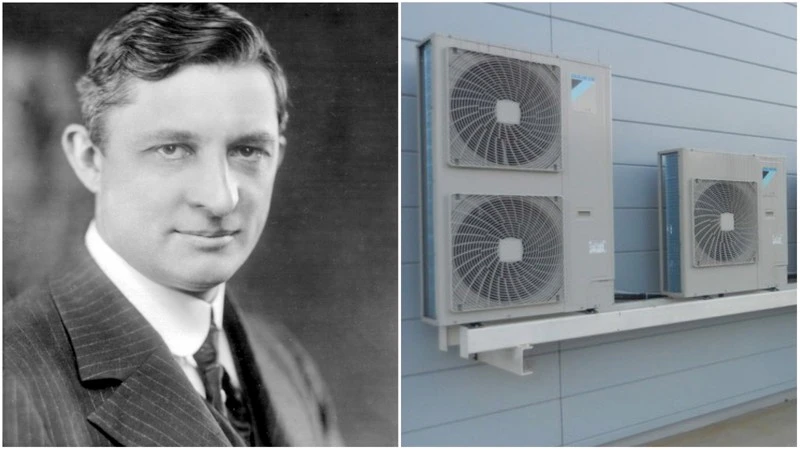
Willis Haviland Carrier invented the first modern electrical air conditioning system on July 17, 1902. A 25-year-old mechanical engineer working in Buffalo, New York, Carrier designed his system not to cool people — but to solve a humidity problem at a Brooklyn printing plant. His invention controlled both temperature and moisture in the air simultaneously, laying the foundation for every air conditioner built since.
Carrier is widely recognized as the Father of Air Conditioning, and his 1902 design remains the direct ancestor of the systems cooling homes and businesses across the country today.
Who Was Willis Carrier?
Willis Carrier was born on November 26, 1876, in Angola, New York. After earning a degree in mechanical engineering from Cornell University, he joined the Buffalo Forge Company, where he was tasked with solving an industrial problem that would change the world.
Carrier was a methodical thinker. According to company history, the idea for his humidity-control system came to him while waiting for a foggy train platform in Pittsburgh — observing how air passing through fog became saturated with moisture. That moment of observation became the blueprint for his 1902 invention.
In 1915, Carrier co-founded the Carrier Engineering Corporation, which grew into one of the largest HVAC companies in the world. He continued innovating until his death in 1950, holding over 80 patents related to air conditioning and refrigeration.
Why Was Air Conditioning Invented?
The first air conditioner had nothing to do with human comfort. The Sackett-Wilhelms Lithographing and Publishing Company in Brooklyn was struggling with a costly problem: summer humidity was causing ink to smear and paper to expand and contract unpredictably, ruining print runs and wasting money.
Carrier’s solution was to circulate air over coils filled with cold water, removing excess moisture from the air and stabilizing both humidity and temperature inside the plant. It worked — and the implications went far beyond printing.
Once engineers realized that controlled air could improve precision manufacturing, the demand for Carrier’s system grew rapidly across industries. If you want to learn how modern air conditioning actually works, the core principle — removing heat and humidity from indoor air — is still exactly what Willis Carrier designed in 1902.
How the First Air Conditioner Worked
Carrier’s 1902 system was elegantly simple in concept:
- Warm, humid air from inside the building was drawn in by a fan
- The air passed over a series of coils filled with cold water
- Heat transferred from the air to the water, cooling the air
- Moisture in the air condensed on the cold coils and drained away
- Cool, dry air was circulated back into the space
This process — heat transfer through refrigerant-cooled coils — is the same fundamental mechanism used in every central air conditioner, mini-split, and window unit today. The refrigerants have changed, the efficiency has improved dramatically, but the physics remain the same.
Cooling Before Willis Carrier: Early Attempts
While Carrier invented modern mechanical air conditioning, humans had been chasing cool air for thousands of years. Here are some of the most notable early cooling methods:
Ancient Egypt
Egyptians hung wet reeds in their windows and doorways. As hot air passed through the damp material, evaporation absorbed heat and cooled the incoming breeze. It was simple, passive, and surprisingly effective in dry desert climates.
Ancient China
During the Tang Dynasty (around 700 AD), Chinese emperors had rotary fans built inside their palaces — some operated manually by servants, others driven by water wheels. These were among the first mechanical devices designed specifically to move air for comfort.
Benjamin Franklin and John Hadley (1758)
In 1758, Benjamin Franklin and Cambridge scientist John Hadley conducted experiments demonstrating that the rapid evaporation of alcohol could cool an object below the freezing point of water. Their work laid important groundwork for understanding evaporative cooling — a concept central to modern refrigeration.
Michael Faraday and John Gorrie (1820s–1850s)
In 1820, Michael Faraday discovered that compressing and liquefying ammonia could produce cooling when allowed to evaporate — essentially the first demonstration of a refrigeration cycle. By the 1840s, Florida physician John Gorrie built an ice-making machine to cool hospital rooms for fever patients, earning him a U.S. patent in 1851. Gorrie is often credited as a forerunner of modern air conditioning, though his system was never commercially successful.
How Air Conditioning Changed the World
It is difficult to overstate the impact of air conditioning on modern life. What started as an industrial tool quickly became one of the most transformative technologies of the 20th century.
- Homes and residential comfort became the norm across hot climates, driving suburban growth in the American South and Southwest
- Hospitals and healthcare facilities used controlled air to reduce infection risk and improve patient recovery conditions
- Offices and productivity improved significantly — studies have shown that worker productivity drops sharply in high heat, and air conditioning reversed that trend
- Movie theaters were among the first public spaces to install AC in the 1920s, drawing crowds not just for films but for the cool air — coining the term “summer blockbuster”
- Data centers and server rooms today depend entirely on precision cooling to keep electronic systems running safely
- Entire cities became viable in extreme climates — Houston, Phoenix, Las Vegas, Miami, and Dubai would not exist in their current form without mechanical cooling
The invention of air conditioning didn’t just make people more comfortable — it reshaped global migration patterns, economic development, and even political power. For those looking at today’s top-rated air conditioning systems, it’s worth appreciating just how far the technology has come from that Brooklyn printing plant in 1902.
How Modern Air Conditioning Has Evolved
Over 120 years of innovation have taken Carrier’s original system and transformed it into a sophisticated, high-efficiency technology that is cleaner, smarter, and more powerful than anything he could have imagined.
Central Air Conditioning Systems
By the 1950s and 1960s, central air conditioning — using a network of ducts to cool an entire home or building from a single unit — became widely available to American households. This was the turning point that made residential AC standard rather than a luxury.
Ductless Mini-Split Systems
Developed in the 1970s in Japan, mini-split systems allow individual rooms or zones to be cooled independently without ductwork, dramatically improving energy efficiency and installation flexibility in older homes and additions.
Smart Thermostats
Modern smart thermostats like Nest and Ecobee connect AC systems to Wi-Fi and learn household patterns, automatically adjusting temperature to save energy without sacrificing comfort. They represent the latest step in making air conditioning more responsive and efficient.
High-Efficiency and Eco-Friendly Refrigerants
Early systems used refrigerants like Freon (R-22), which were later found to deplete the ozone layer. Modern systems use environmentally safer refrigerants such as R-410A and the newer R-32 and R-454B, which have significantly lower environmental impact. Meanwhile, SEER (Seasonal Energy Efficiency Ratio) ratings have climbed from single digits in the 1970s to 20+ in today’s best systems.
If you’re thinking about upgrading your home’s cooling system, choosing the right AC system for your home starts with understanding the options available today — from traditional central air to ductless systems and heat pumps.
The team at Go Houston Heating & Cooling specializes in helping Houston homeowners find the right system for their home, budget, and efficiency goals. Whether you need a new installation, replacement, or just expert advice, our professional air conditioning services are available throughout the greater Houston area.
Final Thoughts
Willis Carrier didn’t set out to change the world — he set out to stop ink from smearing. But his 1902 invention, built on centuries of human experimentation with cooling, became one of the defining technologies of modern civilization.
From ancient Egyptian wet reeds to AI-driven smart thermostats, the story of air conditioning is a story of relentless problem-solving. Every time you adjust your thermostat on a hot Houston day, you’re benefiting from over 120 years of innovation that started with one engineer and one humid printing plant in Brooklyn.
Understanding where your AC came from makes it easier to appreciate — and maintain the system keeping your home comfortable today.